


Find your free speed.
Professional aerodynamic testing for time triallists, triathletes, track and road
riders — from the engineers trusted by record-breaking athletes, Olympic champions and WorldTour teams
Save watts and improve your setup in one session.
Aerodynamic Testing
£1,125.00
/
Couldn't load pickup availability
Why Choose WattShop?
1. 500+ riders tested
2. World Hour Record Engineering
3. UCI WorldTour experience
4. Testing from £750
Testing Locations

Derby Arena

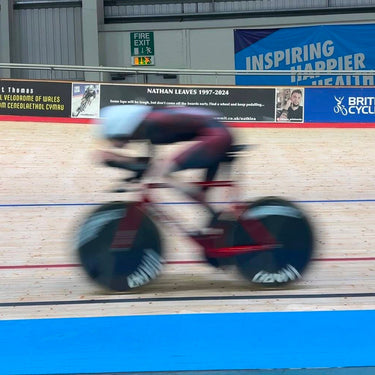
Geraint Thomas National Velodrome

Silverstone Sports Engineering Hub

Catesby Tunnel

On-road
With Streamlines Cirrus
Above ~15 km/h, air resistance is the biggest force holding you back – at racing speeds it’s 80–90% of the power you produce. The number that governs it is your CdA (drag area): how big, and how slippery you and your bike are to the wind.
Training buys watts slowly. Reducing CdA buys speed immediately and unlike fitness, it never detrains. But aerodynamics is unintuitive; changes that look faster often aren’t, and a setup that saves one rider 20 watts can cost another the same.
The only way to know is to measure you.
A typical first session finds 10–30W at race speed.
The Aero Glossary
Become fluent in aero in 60 seconds
Drag
The air pushing back as you ride — 80–90% of your resistance at race speed.
CdA
(Drag Area)
One number for how aero you are. The lower it is, the more slippery you are. Road ~0.30–0.40 TT ~0.20–0.25, Elite ~0.18.
Watts Saved
A CdA difference converted into power at your race speed aka the number that decides whether a change is worth it.
.
Baseline
Your starting setup, re-run throughout the session to prove the data is stable.
Repeatability
Getting the same number twice for the same setup — the test of the test.
Yaw Sweep
Testing across wind angles, not just head-on, because that’s how courses are actually ridden.
Weighted average
Your CdA scored across the air speeds and wind angles your course actually produces, each weighted by how often it occurs — collapsed into one honest figure.
The Aero Testing Spectrum
There's no single "best" aero test – there's a spectrum.
Every testing method sits somewhere on two axes: measurement confidence — how cleanly and repeatably it resolves small differences — and realism — how closely the conditions match the race you’re actually preparing for. Race day itself sits at maximum realism and minimum measurement confidence: it’s the thing we’re all optimising for, and the worst possible place to run an experiment.
A wind tunnel offers the highest measurement confidence available — drag measured directly, to a fraction of a percent — in deliberately simplified conditions. Road testing is the reverse: real roads and real wind, with the Streamlines Cirrus system measuring and normalising what a laboratory would remove. An indoor velodrome blends the two: a controlled, windless environment you genuinely ride in, with completely real riding dynamics. And Catesby Tunnel is the rarity that scores highly on both axes at once — a sealed, laboratory-stable environment in which you simply ride your bike.
The right test isn’t the “top” one. It’s the point on the spectrum that matches your event, your goals and your budget — and the strongest programmes combine points: tunnel confidence for equipment decisions, riding realism for position. In your free consultation we’ll place you on the spectrum before you spend a penny.


The Testing Process
1. Book & Brief
A short questionnaire covers your events, goals, current setup and any flexibility or injury constraints.
2. Pre-test consultation & SpeedMachine simulation
Your performance engineer simulates your race in SpeedMachine (see below), then designs the test plan with you: a structured matrix of positions and equipment, ordered so the highest-value changes are tested first, and matched to the venue with the best cost-to-gain ratio for your goals.
Considering a purchase? Tell us — we’ll bring it from our test library or source it.
3. Test Day
Baseline runs establish your starting CdA, then we work in structured blocks of one to eight tests — baseline, test block, baseline, test block — with live CdA on every run. Bracketing every block with your baseline catches any drift in conditions or rider, proves repeatability, and anchors every result to a known reference. You see the data between runs and we make decisions together, in-session.
4. Report & Debrief
An interactive report covering every run: CdA per configuration, watts saved at your race speed, and clear, prioritised recommendations.
5. Aftercare
Follow-up support, help sourcing the winning equipment — with 10% off any WattShop items purchased within 7 days of your test — and retest options as your position develops.

Your Report
Following each session, we provide a detailed, interactive report analysing aerodynamic performance, including measured CdA data, comparative testing results and recommendations for further optimisation. Explore an example report to understand the outputs generated from a WattShop aerodynamic test.
Choose Your Test

What it is. Indoor track testing at Derby Arena or the Geraint Thomas National Velodrome in Newport — international venues available by arrangement. You ride 8–10 lap blocks at constant speed and power while your CdA is resolved live, run by run, on the AFasterYou AeroTune platform.
Best for. Pursuiters, track sprinters, bunch racers and hour-record attemptees — test where you race. TT and triathlon riders proving a position under real riding dynamics. Checking that a wind-tunnel setup still works when you’re riding unconstrained. Paired and triple sessions to share the venue.
Why it’s valid. An indoor velodrome is a windless, controlled environment you genuinely ride in. No gusts, no terrain, no traffic, a repeatable line — so when measured drag changes between runs, it’s because of the change we made. You’re riding unconstrained at race intensity — real inertia, your body supporting itself exactly as it does in competition — so the position we measure is your real position: hip angle, torso drop and head position under load. Rolling resistance can be resolved alongside CdA, so tyres and pressures get tested too.
Honest limitations. The velodrome isn’t yaw-free — cornering generates its own flow angles — but equipment yaw sensitivity can’t be assessed here: that’s a job for controlled sweeps in the wind tunnel or measured real-world yaw in a Cirrus field test. New track riders may need time to settle into a consistent line, and big test matrices are real physical work — we set run intensity to keep the whole session sustainable.
Sessions. 2 h solo £1,125 (Derby) / £1,250 (Newport) · 3 h solo £1,600 / £1,750 · paired and triple options from £1,350 — a support mechanic is included on all shared sessions.
What it is. Direct drag measurement at the Silverstone Sports Engineering Hub. You and your bike are held on the tunnel platform in smooth, uniform airflow — set to your racing speed, with speed sweeps available all the way to 80 km/h — while a force balance measures aerodynamic drag directly and a turntable sweeps you through the yaw angles your event actually produces. Unlike typical tunnel systems, we can also vary yaw dynamically mid-run: a more realistic test, and high-fidelity yaw data gathered far more rapidly. CdA is computed run by run, corrections applied, live throughout.
Best for. Equipment and position decisions where crosswind behaviour decides the answer — wheels, helmets, frames, fabrics. Speed sweeps that map how a setup behaves across your full racing speed range, from steady TT pace to 80 km/h.
Why it’s valid. The tunnel is the only venue where drag is measured directly — a balance reads the force itself rather than inferring it from power and speed — and results are repeatable to a fraction of a percent. It’s also the only venue where we control yaw. Real-world wind almost never hits you dead-on, and equipment and positions that win at 0° can be worse at 10°: we sweep your event’s yaw range, statically or dynamically, and weight the results into one honest, event-correct number.
Honest limitations. We can match your race power on the platform — but constrained riding can’t reproduce the dynamics of the open road: the inertia you pedal against, and the way your body supports itself when the bike is free beneath you. That doesn’t invalidate tunnel results; it’s why they pair so well with a velodrome or Catesby session, where the position is proven under real riding dynamics.
Sessions. Day: 2 h £1,475 · 3 h £2,175. Evening/weekend: 2 h £1,175 · 3 h £1,725.
What it is. A 2.7 km purpose-built indoor straight road inside a sealed Victorian railway tunnel — laboratory-stable air you ride your own bike through at race power and race speed. The surface is extraordinary: less than 5 mm deviation from true across the full 2.7 km, on a constant, precisely known 1-in-176 gradient — flat, smooth and identical on every single run. We test with the Streamlines Cirrus system: out-and-back runs with extremely high-resolution CdA on every pass.
Best for. TT and triathlon riders validating position and equipment at true race intensity. Riders without track experience — it’s a straight, flat road, so line-holding is never a data problem. High-speed work: the constant gradient means the downhill direction enables very high test speeds — invaluable for road sprinters, capturing repeatable race-speed CdA at speeds impossible to sustain lap after lap on a velodrome. Immediate feedback after every run on how a change actually feels to sustain.
Why it’s valid. Catesby is the rare point on the spectrum that’s high on measurement confidence and realism at the same time: a sealed working section keeps conditions consistent for assured repeatability, while the riding is completely real — dynamic pedalling, real inertia, full race power. The CdA we measure is the CdA you’ll race with.
Rail-tunnel aero testing is unique to WattShop — no other UK provider offers it. It’s also where we do our most demanding work: the combination of the tunnel’s controlled environment and the Streamlines Cirrus system produces exceptionally clear aero data.
Honest limitations. Still air — near-zero yaw, so equipment crosswind sensitivity belongs in the wind tunnel or a Cirrus field test.
Sessions. 3 h solo £2,425 · 3 h paired £2,650 · 4 h solo £3,125 · 4 h paired £3,350 · 4 h triple £3,350 — support mechanic included on shared sessions.
What it is. Real-road testing with the Streamlines Cirrus system — on our validated test roads in Northamptonshire and Oxfordshire, or on carefully selected roads near you. Setup takes ten minutes; you ride out-and-back or loop runs holding position and power, and CdA resolves run by run, measured to within 2 watts at 45 km/h — around 1%.
Best for. First tests, and the most cost-efficient route to a full optimisation — up to 15 setups in a two-hour session, sometimes more. Position work in a genuinely realistic environment. Equipment crosswind response in real, measured wind. Proving a controlled-environment setup out in the world. Ongoing monitoring between sessions.
Why it’s valid. The wind you race in is the wind you should test in. Cirrus measures every key variable that impacts drag performance — air speed and wind angle at the bike, elevation, speed effects, body position — and normalises for them in scientifically valid, advanced ways. This is a genuine test environment, not a compromise: you optimise your position under the conditions you actually ride in, with the measurement rigour supplied by the system. (Full system story below.)
Honest limitations. Weather-dependent — sessions are scheduled around conditions. And the one group it doesn’t suit: track riders, whose racing environment is the velodrome itself.
Sessions. 2 h £750 · 3 h £975 · 4 h £1,175. And we travel — anywhere in the world. For testing beyond our home roads, contact us and you’ll have a quote within one business day.
"Which test is right for me?"
You race on the track
Velodrome
You want your TT/Tri position proven under real riding dynamics
Catesby OR Velodrome
You're choosing wheels or a helmet for a windy course
Wind Tunnel for controlled yaw sweeps OR a Cirrus test in real, measured wind.
.
First test, or the most cost-efficient full optimisation
Field Test
You want laboratory confidence without giving up real riding
Catesby
Not sure?
Book the free call. Your engineer will place you on the spectrum and recommend the best cost-to-gain option for your goals.
What sets WattShop testing apart?
The most advanced real-world aero measurement system available.
Our road and Catesby testing runs on Streamlines Cirrus — a complete aerodynamic drag measurement system born in Formula One and built in Britain.
Cirrus is the brainchild of John Buckley, former F1 aerodynamicist, whose CV includes the Le Mans-winning Porsche 919 wind tunnel programme, the world-championship-winning Mercedes W05 — and Mercedes AMG Petronas F1, where he worked alongside WattShop’s own Dan Bigham. The system’s patented probe design is used by multiple Formula One teams for its unique measurement advantages; on a bike, it precisely measures wind angle and air speed, barometric pressure and temperature, right at the rider.
The rest of the system closes every error path that plagues outdoor testing: FORMA, an infra-red body-position sensor that confirms you’re holding the same position run after run — so a “faster” result is the equipment, not a lucky tuck; TEMPO, a microsecond-precision wheel-speed sensor (off-the-shelf sensors carry timing errors worth ±4 W a lap); NIMBUS, a lossless, time-synchronised data logger; and the Cirrus Portal, where every run is processed with elevation mapping, airspeed stagnation calibration, sail-effect and Reynolds-number modelling built in.
Cirrus is UK developed and manufactured, ridden by multiple WorldTour teams — and WattShop is a close technical partner in its development, helping advance the system so it stays class-leading across every environment we test in. When you test with us, you’re not renting a gadget; you’re testing with the people who help build it.
Every WattShop programme starts with SpeedMachine, our in-house race simulation platform. We feed in your course and your parameters and simulate your race precisely and accurately: how much time aerodynamics, mass, rolling resistance and drivetrain efficiency are each worth on that course; your optimal pacing; your optimal gearing; the exact air-speed and yaw-weighting map your test session should be built around — and much more. Instead of generic advice, you get a quantified answer to the only question that matters: the best way to optimise performance for your exact race scenario and environment, before a single test run is ridden.
Most testing happens at one arbitrary speed and zero yaw. Your race doesn’t. SpeedMachine derives the air speed you’ll actually hold and the distribution of wind angles your course and conditions will produce — and we build the session around them. In the tunnel we sweep those yaw angles and weight the results; in the field, Cirrus measures the real yaw you ride through. Either way, wheels, helmets and fabrics are judged on the wind they’ll actually see. Kona’s crosswinds and a sheltered UK dual-carriageway do not give the same answer — and your recommendations shouldn’t pretend they do.
You don’t have to buy first and hope. We maintain a test library — [extensions, helmets, skinsuits, wheels, hydration systems] — bring shortlisted options to your session, and can source specific items you’re considering. Your report sets out exactly which options made you faster, and by how much — everyone who tests with WattShop gets 10% off any WattShop items purchased within 7 days of their test. We recommend the fastest equipment according to your data, even if that equipment isn't ours.
Frequently Asked Questions
Who is aero testing suitable for?
WattShop aero testing is suitable for any cyclist looking to go faster. Every session is tailored to your individual goals, whether you're chasing a personal best, competing in age-group triathlon, or racing at the highest level.
From dedicated enthusiasts to WorldTour professionals, we use the same proven testing process to help every rider maximise their aerodynamic performance and unlock free speed.
What should I bring to an aero test?
Our Performance Engineer will be in touch before your test to discuss your aims and objectives for the session. They will let you know about any specific items that should be brought along. Please bring all the spacers/bolts for your bars, and your bike set up in full race mode including everything you normally race in be it race wheels, skinsuit, overshoes / calf guards, gloves etc.
We stock a range of equipment for testing, including 22.2mm extensions, a range of stems, various hydration systems, several helmets, and several skinsuits/overshoes. If you want to test something specific please mention it in your call and bring it with you.
Finally, if there is something specific you might want to test but don’t have, let us know and we’ll try and source it for your test.
Can I test different helmets, skinsuits or wheels?
We stock a range of equipment for clients to use during aero sessions. If you have a specific item you wish to test, please let us know and we will try and source it!
Do I need a bike fit first?
Not necessarily. While a bike fit isn't essential before an aero test, we do recommend arriving on a bike and in a position that you're already comfortable riding. Aero testing sessions are focused on identifying aerodynamic gains and refining your position, so you'll get the most value if we're optimising an established setup rather than building one from scratch.
Will I receive the data at the end of the session?
We'll finish your session with a summary of the key findings and the changes that delivered the biggest aerodynamic gains.
You'll receive a detailed interactive test report, giving you full access to your data and allowing you to explore the results in depth. With clear insights and practical recommendations, you'll have everything you need to make informed decisions about your position, equipment and future setup changes.
Something has come up, can I cancel my test?
Provided you give us more than 28 days notice, we can refund your test or rearrange. For cancellations less than 28 days before your test, a charge of 25% will apply.
Where exactly are the venues?
Derby Arena
Geraint Thomas National
Velodrome, Newport
SSEH, Silverstone
Catesby Tunnel, Northamptonshire
Validated field-test roads in Northamptonshire & Oxfordshire.
I've never ridden a velodrome before, can I still test?
Yes, and Catesby and field testing require no track skills at all.
What fitness do I need? How hard is a session physically?
We set run intensity so the whole session is sustainable.
Can two or three of us share a session?
Yes — paired/triple sessions are available on the velodrome and at
Catesby and a mechanic is included in the cost so we can optimise test time.
Are evening Wind Tunnel sessions available?
Yes, evening sessions can be booked at a lower hourly rate.
Do I get a discount on WattShop products?
Yes – we offer aero testing customers a 10% discount on all WattShop products purchased within 7 days of their test.
What happens if weather affects a Field Test?
Sessions are scheduled around conditions and we will rebook the session should weather conditions deteriorate.
Can you come to me?
Yes – we offer field testing internationally. Get in touch and you'll receive a quote within one business day.
Do you check my position is UCI/CTT legal?
Please make us aware of any legality requirements and we will factor these into any changes we make to your setup or your position.
How often should I retest?
We recommend retesting once a year and/or if you make any changes to your setup.